- Home
- /
- Product Design & Manufacturing
- /
- Inventor Forums
- /
- Inventor Ideas
Turn on suggestions
Auto-suggest helps you quickly narrow down your search results by suggesting possible matches as you type.
Inventor Ideas
Share ideas for future product features directly with the Inventor team and collaborate on existing suggestions with your peers.
Options
- Mark all as New
- Mark all as Read
- Float this item to the top
- Subscribe
- Bookmark
- Subscribe to RSS Feed
Idea Statuses
- Gathering Support 10,490
- Under Review 43
- Future Consideration 419
- Accepted 19
- Implemented 962
- Archived 2,426
Showing ideas with category Parts.
Show all ideas

Dear Sir/Madam, i have a cone, for development i converted it to sheet metal, later i came to know that the flat pattern of the cone cannot be cut in one single piece, so, i trimmed it into four pieces then the development cannot be generated as it is done for single cone. so, i has to save that with another name such as development of cone and then i removed the thickness of all the other three parts n then i applied flat pattern it develops which fulfills my requirement, but here my request is to when i want to reuse the part for another project then i can update the cone but i cannot update the development of cone file automatically, so i request you to develop to give an interconnection between parts option it would be help full, one shot two birds there is another option linking EXCEL but all the time excel is not available so i am requesting you to make possible With Regards, M.S.Prasanna.
Show More
0
Votes
In case to have multiple instances (windows) of Inventor running at the same time then it fails to export in 3D PDF in any of the instances but the first one. I realised that Inventor opens the part/assembly in the first instance (then I have 2x open). From the first instance I can export always to 3D PDF. I work with multiple windows when I am working with different projects.
Show More
0
Votes
I'd like to be able to copy (and/or make an associative pattern) of a defined 'Preserve Regions' I have described in a model. I'd like to be able to do this from one feature to another... or associativly from a feature to a selected collection or pattern of features. Best, Brian
Show More
0
Votes

While laboring away on this fine Monday morning, an idea struck me that could be incredibly useful for Inventor workflow (Or at the very least, how I use it). Namely, with making large compartmentalized assemblies/frames that need to be stuck together and otherwise match up, I've been leveraging making part files that exist only of sketches, and deriving specific sketches out into various parts. One good example, making a large cure oven with a frame created through Frame Generator and split into 4 main components, the oven frame, the support frame that it rests on (So we can disassemble it for shipping/installation), the cooldown section (Also removable), and the catwalk (Again, a removable, separate section). I've found that for applications like this, especially when they're really heavy on the Frame Generator, the most effective way to work was to make all these dependent sketches as one large .ipt with no geometry, and making derived parts carrying over the sketches that are needed for each section, which I then throw into an assembly to build the frames. There are a few problems with this method, and places for improvement, so what I'm thinking would be a good addition would be an Inventor file type that exclusively consists of sketches and work features, it might make more sense to outline features I feel would be important. For most purposes, is treated like an .ipt, but without the ability to do any '3D Model' commands However, treat sketches made in it less like features in a part, and more like parts in an assembly, ie. Folders, because making these huge sketch parts turns into a real mess when each "entity" may have multiple sketches to define its parts (Especially when using a combo of 2D and 3D sketches to make up for how finnicky 3D sketches can get), also being able to change visibility of entire sections would be nice Being able to 'derive' the various sketches into regular .ipt files, so they'd work as a regular sketch part would anyways. Heck, it might even be worth to translate every sketch included in the derive into a single 3D sketch for ease of use. Color overrides, while yes the formatting is nice, being able to set an entire sketch to just use an override for their "fully constrained color". Because contrast is a wonderful thing, but changing line format is nowhere near as useful as it could be since it also overrides the color of projected lines and the color applied to non-fully constrained lines, which are both pretty useful. Performing rectangular/circular/mirror patterns on entire 2D or 3D sketches, because what little pattern methods are available to sketches is still lacking compared to what can be done at the part level In that same vein, allow assembly-level feature patterns to use sketch components (Or blocks, or points along a sketch, I really don't care) as their feature to follow. I say this because feature patterns seem less fluid as they could be due to the fact that they can only pattern along geometry, and not say, a well-defined centerpoint or something of the like Being able to constrain straight to the sketches, pretty much like what can be done with 2D sketches, but extend to be able to do so with 3D sketches in the part as well. Because using 3D sketches to outline piping runs and whatnot would be much, much faster and cleaner if every point didn't have to have a work point and every line a work axis just to be able to place components along the guidelines For Design Accelerator assemblies, an option to take the color of their defining line would be very helpful too, as I've found that it's easier both on the design and fabrication side to use colors with large framework, ie. All outer frame is colored blue (With lighter hues indicating thinner tube, for at-a-glance identification), floor supports being brown, ceiling being red, wall supports being different colors unless their symmetric, etc... Same goes for tube and pipe runs though they might actually match their design color. I'm sure I can think up more, if not a way to do this on my own if I can hook into Inventor enough if Autodesk doesn't seem interested.
Show More
0
Votes
iFeatures can be so useful in saving modeling time. In my line of work I often use various bushings which have varying tolerances depending on their diameters. I would love for Inventor to allow for parameters to be placed in the tolerance fields (in this case a deviation tolerance) so that in my iFeature I could change the tolerance and have them show up when I retrieve dimensions on my drawing. I think it is a simple, straight forward idea that many people could benefit from.
Show More

0
Votes
We design our infrastructure projects on the Dutch local coordinate system. These are large values for x, y and z, see appendix. Modeling in Inventor you want to close to zero, base point. To be able to work with coordinates, I like to have a reference point with which coordination can be calculated. I think this also works in Revit. So modeling close to zero and calculate the coordination of movement.
Show More


0
Votes

 pierre.masson
on
04-25-2016
01:28 AM
Submitted on
04-25-2016
01:28 AM
Status:
Archived
pierre.masson
on
04-25-2016
01:28 AM
Submitted on
04-25-2016
01:28 AM
Status:
Archived
We have some iPart Member which we would like to be empty (all features suppressed).
We are using formulas in a separate Excel sheet saying that if a parameter reaches a specific value, all features should be suppressed.
Show More
0
Votes
More than once i rename my solid bodies, but it's a serious hasle to find them sometimes + my neurotic defect isn't satisfied in not being able to sort it 🙂 Would it be possible to sort them in the future? Something like in screenshot below? Thanks
Show More
0
Votes
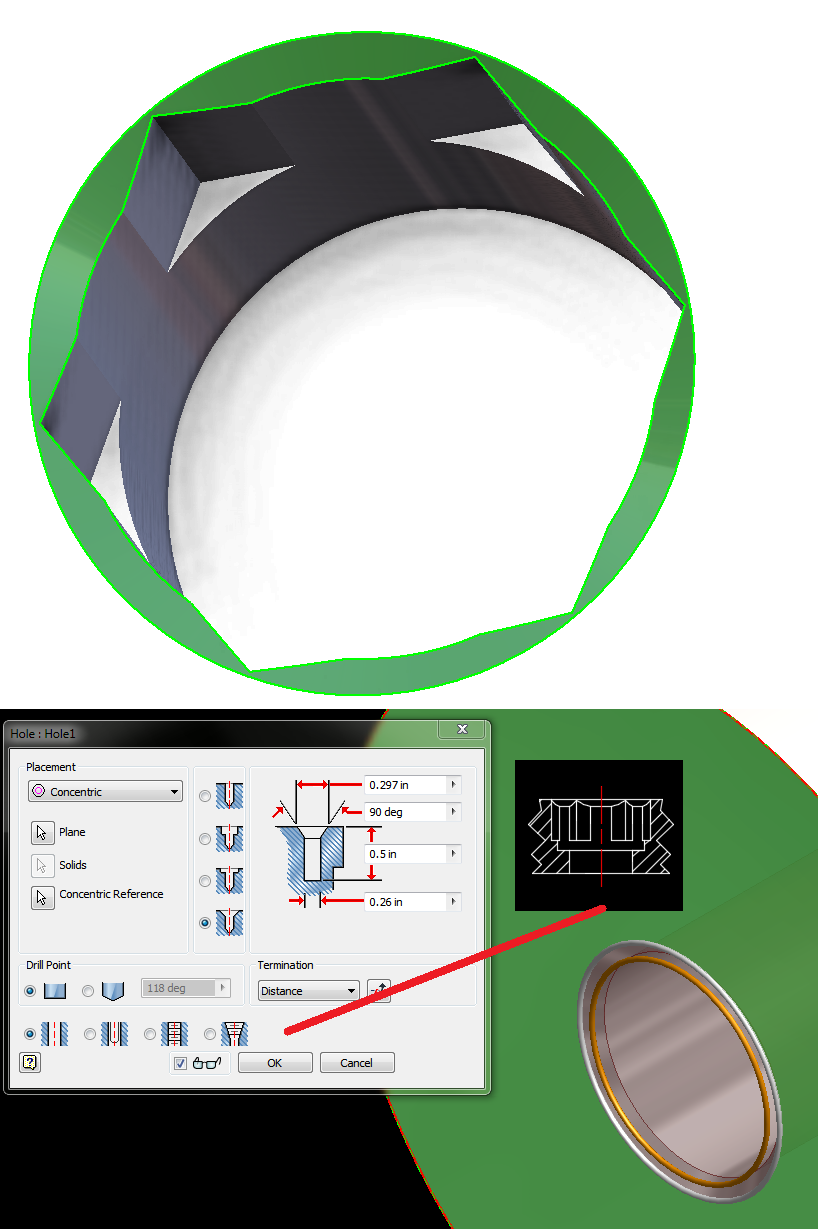
I'd like the ability to use the hole command to create broached holes per ASME B18.3 with the hole note on the drawing something like: Ø.26 MAX X .31 MAX V Ø.297 MAX X 90° BROACH 1/4 HEX X .25 MIN (depth and countersink symbols as appropriate) The reason I ask, is that the broach is formed by a tool not unlike a thread tap in the sense that one doesn't modify it on a daily basis to create a conforming part. It seems silly to put a toleranced, reference, or basic dimension on a hex feature that is cut by a purchased tool (that is always manufactured to the high side of the allowed tolerance to boot). A call out for the nominal tool size make a lot more sense to me. Calculating the allowed hole size and edge break is a chore as well. I will probably make a tabulated iFeature for the immediate future, but a built-in solution would be awesome.
Show More
0
Votes
The idea is to have in some place for example iproerties a window where documentation files (e.g. pdf or other files that reffer to model) or shortcuts can be placed.
Show More
0
Votes

 krancuretDX4VB
on
04-06-2016
09:26 AM
Submitted on
04-06-2016
09:26 AM
Status:
Archived
krancuretDX4VB
on
04-06-2016
09:26 AM
Submitted on
04-06-2016
09:26 AM
Status:
Archived
Inventor provides an orthographic view and perspective view option. It would be nice if Inventor had a view option that would limit the size of objects as viewed on the monitor so they couldn't get bigger than real life size. I am imagining a view where you could still zoom out as far as you wanted, simulating a scenario where you were walking away from a part in real life, but you would be limited on how far you could zoom in (or how close you could get to the part). Right now I can zoom in on a 1/4-20 screw to where one thread takes up my entire monitor. This has significant advatanges, but it also makes it slightly difficult to visualize the real life size of objects. Putting familiar references in the model such as a person or just a hand aid in getting a better understanding of the size of the parts being designed, but I still come across scenarios where I've designed an object and then see it finished in the shop a few weeks later and it is smaller or bigger than I was imagining. So a handy view option would be one that does not allow you to zoom in any more once the part reaches its real life size on the monitor. Using the 1/4-20 screw example, the view option would let you zoom out (walk away) from the part as far as you wanted, but then it would stop allowing you to zoom in when the shank was physically 1/4" on the monitor. I know monitors all have different pixel counts and I haven't thought thru how one would accomplish this, but I'm just posting the idea.
Show More
0
Votes
myself being a student,the other day i was writing my record and i observed that displaying the essay(which is now a soft copy) i needed to copy on my record would make it efficient and error free if i had my words on my record using mini projector..
Show More
0
Votes
I'd like to be able to easily modify the location and orientation of (index and move) a derived model at the time of placement and after placement. I know I can use the Direct Edit toolset to accomplish this, but it's a bit cumbersome and after the fact. Ideally, I'd like to have the same type of controls we have when placing a component in an assembly.... Only available during the Derive workflow. Best, Brian
Show More
0
Votes
I have not been able to place the measure tool in the quick access toolbar since INV 2013.
Show More
0
Votes
This is a request from 2014 userr in japan called SHINKAWA. When you try to make amodel with mutiple sweep line, you can not generate the model at onece. you need to click other object with "Ctrl" button. want to make the model at onece.
Show More
0
Votes
Direct Edit would be even better with a Create New Solid option (like extrude has)! I know some workarounds with surface thickens to slpit afterwards but would like a built-in option for my multi-solid parts. Direct Edit is otherwise a great feature!
Show More
0
Votes
I'm afraid this is yet another order of operations complaint regarding the thread feature. We typically turn our parts before cutting threads; not vice versa. Threads do not show up correctly in the drawing unless they are cut prior to any undercutting geometery (e.g. a lead-in chamfer). This is due to the fact that the maximum extent of a thread feature is defined solely by the selected face unless a truncated length is given. I'd like the ability to select a face or work plane to define the terminations of a thread feature. Or instead; be allowed to specify a negative offset to define the start of the threads, and use another offset to end them. Anything that would allow me to tell Inventor where the tool will be cutting beyond a single face would be appreciated as it would allow me to create a feature tree that reflects my shop's operations, and a drawing that reflects the final part.
Show More
0
Votes
Hi, Often with the error messages I find the information useful and like to leave them turned on. I do not like having to clear the box every time I recieve one. for example when a sketch would be over constrained or already exists. Would it be possible to add a new option to the various prompts to have them come up as a popup message like the save reminder rather than have them require a user response to clear?
Show More
0
Votes
 frank_schalla
on
07-17-2015
11:39 PM
Submitted on
07-17-2015
11:39 PM
Status:
Archived
frank_schalla
on
07-17-2015
11:39 PM
Submitted on
07-17-2015
11:39 PM
Status:
Archived
In every early design state we work with a single part file (multibody). Later we then create the parts and place standard components gears / engines and so on to this layout. What we miss is the possibility to create inside the first part profiles like tunes and Steelprofiles and change the size easy. At the moment we work with a scetch block lib but changing is a pain. The biggest goal will be when we can create table driven Ifeatures per profile type. This works like a charme but Ifeature can not create new bodies 😞 ?? This as a option and the game will change 🙂 Another way can be to make the Content Center Elements table driven.
Show More
0
Votes
It would be handy to allow a plane to be created based upon two coplanar axes. Right now Inventor allows for a plane to be created based upon two coplanar edges; seems to me using axes would be the same result. Right now I have a sketch with a line drawn at a specific angle from vertical and another sketch which is symmetric to it about the XY plane. I need to create a plane through those two lines in two sketches. This is a bit cumbersome because I have to create and dimension two sketches in order to create the plane. Alternatively, I could create an axis through the first sketched line and mirror it over and use those two axes to create the plane...much quicker.
Show More
0
Votes
Categories
-
2D-3D Sketch
1,788 -
API-iLogic
761 -
Assemblies
4,012 -
Content Center
1 -
Documentation
1 -
Drawings
3,687 -
Frame Generator
344 -
Install-Graphics-UI
848 -
Installation
1 -
Libraries
491 -
Model states
307 -
Other
1 -
Other Add-ins
1,081 -
Parameters
770 -
Parts
3,361 -
Performance
737 -
Presentations
536 -
Product Updates
1 -
Properties
899 -
Server
1 -
Sheet Metal
797 -
Translators
284 -
Tube&Pipe
432 -
Weldments
345
- « Previous
- Next »