
Discovering the power of 3D
Ramírez's journey began at the National Autonomous University of Mexico (UNAM), where he studied architecture. Although he was drawn to design, it was a chance encounter with digital visualization that changed the course of his career.
"I remember attending a presentation at the Faculty of Architecture while I was still a student," he recalls. "Two speakers showed projects created with digital tools. At the time, I barely knew how to use any 3D software, but seeing what was possible completely fascinated me. That's when my interest in this world really began."
That fascination led him beyond traditional architectural practice. He earned a master's degree in 3D Animation from Universitat Pompeu Fabra in Barcelona, an experience that broadened his understanding of visual storytelling, animation, and digital environments.
Early in his career, Ramírez found himself equally drawn to architectural visualization and BIM. "At first I was interested in the visual potential of the digital model," he says. "Over time, I realized that a model wasn't just a way to represent a project. It could coordinate information, automate processes, improve decision-making, and communicate design intent."
Later, he completed a master's degree in project management from UNAM and postgraduate studies related to visual programming and parametric design. In addition to his formal academic education, he’s pursued specialized training in BIM management, automation, AI applied to AEC, and advanced architectural visualization, which have been central to his current professional work.

From modeler to technology strategist
Between 2014 and 2016, Ramírez worked as a BIM modeler at ICA BIM, contributing to major infrastructure projects throughout Mexico, including work related to the expansion of Mexico City's Periférico ring road and other large-scale transportation initiatives. "That period was very important because it allowed me to understand the relationship between geometry, coordination, information, and documentation on large projects," he says.
In 2017, Ramírez worked as a 3D generalist on the SYNTHIA project, affiliated with the Computer Vision Center in Barcelona. The initiative used synthetic urban environments to help train artificial intelligence systems. "For me, it was a highly significant experience because it combined 3D, synthetic urban environments, computer vision, and artificial intelligence," he says. "Looking back, it was one of my first real encounters with the convergence of visualization and AI."
Alongside his consulting work, education became another defining part of his career. Ramírez helped create BIM training programs at UNAM's Faculty of Architecture, including the BIM Modeling Diploma Program and the BIM Project Coordination and Management Diploma Program. "That work has been crucial because it has allowed me to train professionals, structure technical knowledge, and introduce BIM to new generations of architects, engineers, and specialists," he says.
Bringing disciplines together
Today, Ramírez's work spans consulting, training, applied research, and workflow development. His focus areas include BIM management, digital project coordination, automation, AI integration, architectural visualization, and professional education.
Rather than viewing these disciplines as separate specialties, he sees them as parts of a larger ecosystem. "To me, BIM, ArchViz, and animation have always been connected," he explains. "BIM organizes project information. ArchViz communicates its visual value. Animation transforms space into a narrative experience. Together, they create a much more complete understanding of a project."
For much of his career, those connections were difficult to establish because workflows and software ecosystems were fragmented. That is beginning to change.
"I don't think the problem was that these worlds couldn't collaborate," he says. "We simply didn't always have the right processes to connect them. Today, that convergence is much clearer thanks to automation, real-time technologies, interoperability, and artificial intelligence."
Influences from architecture to cinema
Ramírez draws inspiration from a wide range of creative fields. His influences include architectural visualization artists such as BBB3VIZ, Alex Roman, and Adán Martín, as well as film, animation, photography, video games, and leading visual effects studios.
"I'm fascinated by visual worlds that do more than demonstrate technical skill," he says. "The ones that create atmosphere and deliver an experience are the ones that stay with me."
That emphasis on atmosphere is evident in his own work. "When I create a scene, what I strive most to convey is mood—atmosphere and experience."
The same philosophy shapes his approach to BIM. He is particularly inspired by professionals who see digital tools not merely as production software, but as systems for improving how information flows through a project. "For me, BIM is not just about modeling. It's about managing information, coordinating disciplines, automating tasks, and supporting better decisions."
Exploring AI in production workflows
As AI tools have become more widely available, Ramírez has focused on understanding how they can contribute to real-world production workflows rather than treating them solely as image-generation tools.
"I became interested in AI very early as a tool for visual exploration," he says. "But I quickly realized it could be much more than that. It can accelerate stages of the creative and technical process that traditionally consume a lot of time."
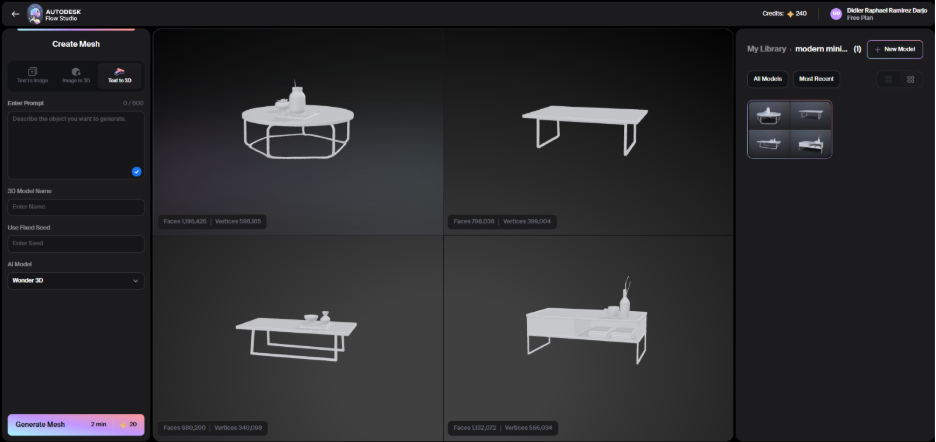
One example is his experimentation with Autodesk Flow Studio, which enables users to generate 3D assets from text prompts or images and integrate them into traditional production pipelines.
What attracted him was not the ability to create finished images instantly, but the opportunity to accelerate early-stage asset creation and exploration. "The problem it solves best is speed during the initial phases," he explains. "It allows you to move quickly from an idea to a three-dimensional asset that can serve as a starting point for composition, scale, atmosphere, and visual direction."


In his workflow, assets generated in Flow Studio are refined and integrated into larger scenes using tools such as 3ds Max and Arnold. "For me, the ideal workflow isn't AI versus traditional software," he says. "It's AI plus traditional software."
Looking ahead
Ramírez believes the future belongs to professionals who can bridge technical and creative disciplines while embracing new technologies thoughtfully. He sees enormous potential for AI in AEC workflows—not only for visualization, but also for automation, documentation, review, coordination, and decision-making.
"What excites me most is reducing the distance between an idea and a tangible prototype," he says. "AI allows us to explore more options, compare alternatives faster, and spend more time on judgment, visual direction, and problem-solving."
If he could offer advice to his younger self, it would be simple: "Don't just learn tools. Learn to connect worlds." That philosophy has guided his entire career—from architecture student to BIM specialist, educator, visualization artist, and AI advocate. And as technology continues to reshape how projects are designed, communicated, and delivered, Ramírez remains focused on the same goal that first drew him into the world of 3D decades ago: helping people understand design intent more clearly.
"Architecture doesn't exist only in drawings or technical models," he says. "It also exists in the way people imagine and experience it before it's built." For Ramírez, technology is ultimately a means to make that experience richer, more efficient, and more human.



You must be a registered user to add a comment. If you've already registered, sign in. Otherwise, register and sign in.