1. Introduction
The introduction of Building Information Modeling (BIM) has transformed design, construction, and operation processes from graphical representations to integrated digital models containing geometry and data. However, this evolution has generated an emerging challenge: the management of the information produced.
The technical literature shows that data fragmentation, lack of quality control and lack of defined responsibilities significantly reduce the value of digital models in operational phases. Information governance arises as a response to this problem, providing a structured framework to ensure consistency, traceability, and reliability.
In the context of ISO 19650, information is no longer a by-product of the design, but a managed asset that supports decision-making throughout its lifecycle.
2. Conceptual framework: data, information and information assets
From the perspective of asset management established in ISO 55000, information is recognized as an organizational resource that directly contributes to the achievement of an organization's strategic objectives (ISO 55000, 2014). However, not all information has the same level of value or the same degree of maturity. Understanding how BIM environments can deliver long-term value requires a conceptual distinction between data, information, and information assets.

2.1 Data: Basic Units Without Context
Data represents the most elemental level of the informational hierarchy. They are isolated records, numerical or textual values that describe a characteristic, but by themselves do not explain its meaning or relevance. In a BIM model, examples of data include geometric dimensions, alphanumeric codes, resistance values, electrical powers, or element IDs.
At this stage, data alone does not allow decisions to be made. A value such as "15 kW" or "DN150" is of no use if you do not know which system it belongs to, where it is located on the asset or what its operational function is. From asset management, data is necessary but insufficient.
2.2 Information: Data with meaning and context
Information arises when data is related to each other and interpreted within a technical, functional or spatial framework. Contextualization transforms isolated records into usable knowledge.
For example, the "15 kW" data becomes information when it is associated with a specific pump, located in a given technical room, which is part of a drainage system. This involves spatial, functional and systemic relationships that allow us to understand the role of the element within the asset.
In BIM environments, this transition occurs when model parameters are linked to objects, systems, locations, and classifications. The model is no longer just geometry, but represents the logical structure of the built asset. Even so, although the information is already interpretable, its strategic value is still limited if it is not formally managed.
2.3 Information Assets: Purpose-Managed Information
An information asset is information that has reached such a level of maturity that it is recognized as a resource that generates organizational value. For the information to be considered an asset, it must meet certain conditions:
- Be structured under defined standards and taxonomies.
- Have an explicit purpose linked to business processes or operations.
- Have quality control and validations.
- Have those responsible assigned for their maintenance.
- Be available to decision makers.
In the BIM context, a set of equipment data becomes an information asset when it is integrated with maintenance processes, performance analysis, replacement planning, or risk management. Information ceases to be a passive record and feeds critical processes such as predictive maintenance, failure analysis or resource optimization.
2.4 Transitioning into BIM
The transformation of data into information assets does not happen automatically. It requires governance. In the absence of structures, standards, and controls, BIM models can contain large amounts of data that do not translate into operationally usable information.
The transition occurs when:
- The model data is structured using standard classifications and parameters.
- Information requirements linked to operational needs are defined.
- Validation and quality assurance processes are established.
- Information integrates with external systems, such as asset management, maintenance, or risk analysis platforms.
At this point, the BIM model evolves into an Asset Information Model (AIM), where information is no longer limited to design or construction but underpins decisions over decades of operation.
2.5 Strategic value
From the perspective of ISO 55000, information assets support risk, performance, and cost-based decision-making throughout the lifecycle (ISO, 2014). The proper management of these assets reduces uncertainty, improves operational predictability and contributes to the resilience of the physical asset.
Thus, the data-information-information asset hierarchy is not only a conceptual model, but the basis for understanding why information governance is essential for BIM to generate value beyond the design stage.

3. Definition of information governance
Information governance is the framework by which an organization defines how information is created, structured, controlled, shared, and preserved throughout the lifecycle of an asset. In BIM contexts, where digital models operate as containers for technical, geometric, and documentary data, governance is the mechanism that transforms information into a reliable resource for decision-making, preventing data from degrading, duplicating, or losing traceability.
From a formal perspective, information governance can be defined as the integrated set of policies, processes, roles, and technologies that ensure that information meets criteria of quality, traceability, availability, consistency, and security. In other words, it's not just about "managing files" or "organizing models," but about ensuring that the information produces sustained value, while maintaining its technical integrity and alignment with business and operational objectives.
3.1 Governance under ISO 19650
The ISO 19650 series establishes a systematic approach to the "organization and digitization of information on civil engineering buildings and works, including BIM (ISO 19650-1)." This framework does not define BIM as a collection of tools, but rather as an information management process, where value is realized through the ability to produce and use information in a controlled manner throughout its entire lifecycle.
ISO 19650-1 introduced the concept of information management as an organizational discipline. This implies that governance must ensure that information is fit for purpose, at the right time and under verifiable conditions. Therefore, governance is not an additional layer to the BIM process: it is the foundation that enables the reliability of the information flow, from its production to its operational use.
3.2 Beyond technology: governance as a socio-technical system
A common mistake in BIM implementations is to reduce governance to tools: a CDE, a template, a parameter set or a folder structure. While these components are necessary, ISO 19650 emphasizes that the process requires organizational management, definition of responsibilities, and systematic control of deliverables and reviews.
This makes governance a socio-technical system: it depends on both platforms and management decisions.
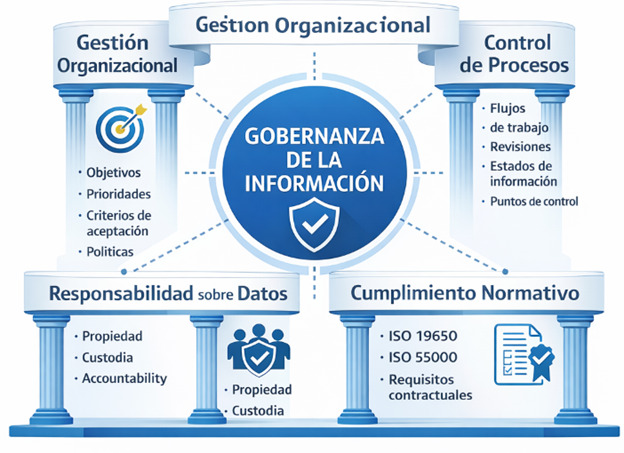
In practical terms, governance integrates four dimensions:
- Organizational management: defines objectives, priorities, acceptance criteria and information policies.
- Process Control: formalizes workflows, review cycles, information states, and control points.
- Responsibility for data: assigns ownership, custody and accountability over the information produced.
- Regulatory compliance: ensures alignment with information management standards and contractual requirements.

This integration allows information not only to be produced, but also managed with criteria equivalent to those of any critical asset in the organization.
3.3 Criteria that define governance: quality, traceability and availability
In complex asset or infrastructure contexts, the usefulness of information depends on its reliability. Governance seeks to ensure three fundamental properties:
- Quality: information must be complete, correct, consistent, and up-to-date. This implies not only technical validation, but also integrity control over time.
- Traceability: there must be the ability to track changes, decisions, revisions and managers. Traceability turns information into verifiable evidence, critical in regulated or critical environments.
- Availability: information must be accessible to enabled roles, when required, and in interoperable formats. Availability includes security, permission control, and preservation.
ISO 19650-2 reinforces these principles by establishing the need for clear procedures for the delivery, review, authorization, and publication of information in collaborative environments.
3.4 Governance as the basis for turning information into assets
Governance is the bridge between BIM and strategic asset management. Without governance, a model can be rich in data, but poor in value: inconsistent, unvalidated or non-traceable information can hardly be integrated into operation, maintenance or risk analysis. With governance, on the other hand, information becomes suitable for reuse, supports continuity between phases and can evolve towards an Asset Information Model (AIM), enabling decisions for decades.
In this sense, governance not only "organizes" information: it turns it into an organizational asset. This transition is consistent with the logic of ISO 55000, where information is considered a key resource for managing performance, risk, and cost of physical assets throughout the lifecycle. Governance is, therefore, the enabling condition for BIM to generate sustained return over time.
4. Components of governance
4.1 Information requirements – the point of origin of the value
Within the framework of the ISO 19650 series, information requirements are the fundamental mechanism that connects an organization's strategic objectives with the information that is produced in BIM processes (ISO, 2018b). Without this initial definition, data production becomes reactive, fragmented, and misaligned with real asset management needs.
From a governance perspective, information requirements represent the starting point in the transformation of data into information assets, since they explicitly establish what information is necessary, for what purpose, at what time and under what quality conditions.
4.1.1 Hierarchy of information requirements
ISO 19650-1 and 19650-2 propose a hierarchical structure that links organizational strategy with the production of information in projects:

- OIR (Organizational Information Requirements): Define information needs at the organizational level. They are linked to corporate strategy, risk management, financial planning and asset portfolio management. OIRs establish what information is required to make business decisions, such as investment prioritization or asset performance evaluation.
- AIR (Asset Information Requirements): They derive from OIRs and focus on the information needed to operate and maintain a specific asset. They include data on performance, maintenance, reliability, energy consumption, safety, and risk. AIRs are essential so that the information in the BIM model can become a useful asset during the operational phase.
- PIR (Project Information Requirements): They refer to the information needed to manage the project itself: scheduling, costs, change control, coordination, and construction risk.
- EIR (Exchange Information Requirements): They define what information should be exchanged between parties at each point in the process, specifying formats, levels of information, standards, and timelines.
This hierarchy ensures that the information produced in BIM models responds not only to design needs, but also to long-term organizational and operational requirements.
4.1.2 From necessity to structured data
Information requirements play a critical role in governance because they establish intent before data is produced. When correctly defined:
- They avoid the generation of irrelevant information.
- They ensure consistency between disciplines.
- They facilitate traceability between strategic decisions and model data.
- They allow you to plan the structure of parameters and classifications.
In this way, the information requirements act as a filter that determines what data has the potential to become information assets.
4.1.3 Relationship with asset management
From the perspective of ISO 55000, assets should be managed by considering risk, performance and cost throughout their lifecycle. AIRs represent the direct link between BIM and this asset management logic, as they specify the information needed to plan maintenance, analyze failures, optimize resources, and reduce operational uncertainty.
Without well-defined AIRs, the information generated during design and construction is rarely usable in operation, which breaks the informational continuity between phases.
4.1.4 Governance and control
Information requirements also establish quality criteria. They not only define what information is needed, but also:
- Level of information required (ISO 7817-1).

- Exchange formats and standards (ISO 16739 – IFC).

IFC Road - buildingSMART International
- Classification structures (ISO 12006-2).
This makes requirements a control instrument that guides the production, validation and acceptance of information.

UNE-EN ISO 12006-2
4.1.5 Impact on the creation of information assets
When information requirements are aligned with strategic objectives, the data produced in BIM models has a high probability of becoming information assets. Governance starts here: in the intentional definition of what information should exist to sustain future decisions.
In the absence of this stage, the information generated lacks direction, and the possibility of reuse in operation decreases significantly.
5. Lifecycle governance
The information associated with a built asset is not static or limited to a single phase. It is generated, transformed, and used differently in design, construction, operation, and renovation. However, historically, these stages have functioned as isolated informational domains, with breaks in the transfer of data and loss of knowledge between phases. Information governance, within the framework of ISO 19650, emerges as the mechanism that guarantees continuity, coherence and traceability throughout the entire life cycle.
5.1 Historical fragmentation and the need for continuity
Traditionally, the information produced in design was delivered as static documentation (plans, reports, spreadsheets), which was rarely integrated in a structured way into the operation phase. As a consequence, operators and asset managers had to reconstruct databases, reinterpret documentation, and regenerate information that had already been produced, but not governed.
This phenomenon generates duplication of efforts, loss of traceability and increased operational risk. Information governance addresses this problem by establishing structures, responsibilities, and processes that allow information to evolve in a controlled way between phases.
5.2 Design: origin of the informational structure
In the design phase, governance focuses on defining standards, data structures, nomenclature, and classifications. Here the foundations are established that will allow the information to be reusable in later phases. The decisions made at this point – such as the definition of parameters, codes and classification structures – condition the future ability to integrate information with operating systems.
Governance in design ensures that information is not generated arbitrarily, but aligned with defined requirements (OIR, AIR, EIR) and with quality and consistency criteria.
5.3 Construction: change control and traceability
During construction, information evolves rapidly through adjustments, design changes, product replacements, and on-site modifications. Without governance, these changes are partially or inconsistently documented, affecting the reliability of the final information.
Governance introduces review processes, information states, version control, and approval flows, typically managed through the Common Data Environment (CDE). This allows decision traceability to be maintained and ensures that as-built information faithfully reflects the built asset.
5.4 Operation: Integration with Asset Management
The operational phase is where the information reaches its greatest strategic value. Here, models and databases need to be integrated with asset management, maintenance, energy management, and risk analysis systems. This integration is directly linked to the principles of ISO 55000, which state that asset management should be based on reliable information to optimise performance, cost and risk (ISO, 2014).
When governance has been applied in previous phases, information can feed processes such as predictive maintenance, intervention planning, reliability analysis, and performance management. The BIM model evolves towards an Asset Information Model (AIM), where information is no longer a project deliverable and becomes a continuous support for the operation.

5.5 Renovation and reuse
In phases of renewal, expansion or reuse of the asset, governance allows reliable historical information to be retrieved, avoiding the need for extensive surveys or data reconstruction. Governed information acts as technical memory of the asset, facilitating informed decisions about future interventions.
5.6 Informational continuity as a governance principle
ISO 19650 promotes information management as an ongoing process that transcends individual projects. Governance ensures that information is not 'rebooted' at every stage, but maintains consistency and traceability throughout the lifecycle.
In this sense, governance is not a one-off process, but a permanent condition that sustains the integrity of the digital asset, allowing information to evolve along with the physical asset and retain its value over decades.
5.7 Information governance as the foundation of the Digital Twin
The concept of Digital Twin has gained relevance in recent years as an evolution of digital models towards dynamic, connected environments capable of reflecting the behavior of the asset in real time. Logic-oriented platforms, such as emerging digital twin management solutions in the AICO ecosystem, show that the industry is moving from static models to living digital infrastructures.
However, the existence of a Digital Twin platform does not guarantee, by itself, the reliability of the system. A digital twin can only be considered as such when it is underpinned by structured, traceable and quality information. In the absence of information governance, the result is sophisticated visualization, but not an environment conducive to decision-making.
Governance acts as an indispensable prerequisite for the Digital Twin to have operational value. Sensors, real-time data, and 3D models only become a trusted digital representation when:
- The base information has been defined by Feature Aligned Requirements (AIR).
- The model data maintains semantic and structural consistency.
- There are those responsible for the updating and quality of the information.
- Change traceability allows you to understand the current state of the asset.
- Information can be integrated with maintenance management and performance analysis systems.
From this perspective, the Digital Twin does not replace governance: it depends on it. Without an information management framework, the digital twin risks becoming an attractive visual environment that is disconnected from operational processes. With governance, on the other hand, the Digital Twin is transformed into a dynamic extension of the Asset Information Model, capable of supporting decisions based on real-time data, predictive analytics and risk management.
Information governance not only underpins the value of BIM in operation, but is also the enabling condition for Digital Twins to evolve from graphical representations to true asset management platforms.

Autodesk- AICO Digital Twin for Facility and Asset Operations
6. Digital control and automation
The evolution of digitalization in the AICO industry has made it possible to incorporate automated mechanisms for validation, verification, and quality control of information. These capabilities represent a significant step over traditional manual review-based processes, but their true value is only achieved when they operate within a clearly defined governance framework (ISO, 2018a).
Automation is not governance in and of itself. Rather, it acts as an enabler that reinforces previously established policies, processes, and responsibilities. In the absence of these elements, digital tools can generate a false perception of control, while structural problems of information quality persist.
6.1 Automation as an extension of information management
In BIM environments, information is generated massively and at multiple levels of detail. Manual review of consistency, completeness, or standards compliance becomes impracticable in complex models. Automation allows quality control to be escalated using out-of-the-box rules that verify:
- Presence and correct format of parameters.
- Consistency between classifications and categories.
- Compliance with nomenclature.
- Detection of inconsistent or missing values.
- Integrity of relationships between objects and systems.
These automated controls align with the digital information management principles promoted by ISO 19650, which emphasize the need for reliable and verifiable information.
6.2 Detect inconsistencies and prevent errors
One of the most important contributions of automation is its ability to identify inconsistencies before information advances to later stages. Parameter errors, duplication of data, or incorrect classifications can compromise interoperability and the use of information in operation.
By implementing automated validations, you reduce the likelihood that incorrect information will be consolidated as part of the digital asset. This preventative approach reduces rework and improves the reliability of the model as a source of truth.
6.3 Continuous vs. spot control
Traditional quality assurance processes are often isolated events—pre-handover reviews or one-off audits. Automation allows you to establish continuous control, where validations are executed periodically or even in real time, integrated into the workflow.
This permanent control is consistent with the lifecycle approach promoted by ISO 19650, where information is considered an evolving resource and must be kept under control throughout the process (ISO, 2018a).
6.4 Limits of automation
Despite its benefits, automation has clear limits. Tools can verify formal rules, but they cannot replace management decisions or strategic criteria. They don't define what information is relevant, establish accountability, or ensure that data is used appropriately.
Therefore, automation should be understood as a component within a broader governance system, where organizational policies, defined roles, and human review processes remain essential (ISO, 2018b).
6.5 Automation in support of the creation of information assets
When integrated into a governance framework, automation empowers the transformation of data into information assets. By ensuring consistency, traceability and quality, it reduces the uncertainty associated with information and increases its reliability for decision-making in operation, maintenance and risk management.
Thus, automation does not replace governance, but rather empowers, providing scalability and efficiency in the control of digital information.

Autodesk- AICO Digital Twin for Facility and Asset Operations
7. Strategic Impact
Information governance should not be understood as an isolated technical or administrative exercise, but as a strategic component that directly influences asset performance and organizational results. From an asset management perspective, value is measured in terms of performance, risk, and cost over the lifecycle. In this context, governed information becomes a key enabler for informed decision-making and resource optimization.
7.1 Reduce operational risk
Asset management recognizes risk as one of the central factors in decision-making. Information governance reduces uncertainty by providing reliable data on equipment condition, intervention history, system performance, and actual asset configurations. When information is incomplete or inconsistent, operational decisions are based on assumptions, increasing the likelihood of failures, disruptions, and critical events.
The availability of structured and traceable information makes it possible to identify potential risks, prioritize interventions and anticipate failures, strengthening the safety and reliability of the asset.
7.2 Improve asset resiliency
An asset's resilience relates to its ability to resist, adapt, and recover in the face of adverse events. Governed information contributes to this resilience by providing visibility into dependencies between systems, technical configurations, and operating conditions.
In complex environments, a lack of reliable information makes it difficult to respond to emergencies or operational changes. Governance ensures that critical data is available, up-to-date, and accessible, facilitating decision-making in contingency scenarios.
7.3 Predictive maintenance planning
One of the most significant impacts of governance is its contribution to the transition from reactive maintenance to predictive and condition-based approaches. By integrating BIM model information with maintenance management systems, you can analyze performance trends, component lifecycles, and failure patterns.
This approach reduces unplanned interventions, optimizes resource usage, and extends asset lifespans. The reliability of these analyses depends directly on the quality and consistency of the information, which underscores the importance of governance.
7.4 CAPEX and OPEX optimization
Informed decision-making influences both capital investments (CAPEX) and operating costs (OPEX). During the design phase, the availability of structured information makes it possible to evaluate technical alternatives considering long-term performance, not just initial costs.
In operation, governed information facilitates the planning of replacements, inventory management and the optimization of interventions, reducing unnecessary expenses and improving financial efficiency. The relationship between trusted insights and cost optimization reinforces the link between BIM and strategic asset management.
7.5 Convergence of BIM and Asset Management
Information governance acts as the point of convergence between the BIM methodology and the asset management principles defined in ISO 55000. Without governance, BIM remains limited to project phases. With governance, the information produced is integrated into operational processes, supporting decisions based on performance and risk.
Consequently, the strategic impact of governance is not limited to technical efficiency, but translates into measurable organizational value, aligning digitalization with long-term business objectives and sustainability.
7.6 Measuring Information Governance Performance
Information governance, being linked to asset management, must be assessed in terms of performance, risk and cost, following the logic of ISO 55000. Measuring its effectiveness allows us to demonstrate that it is not an administrative effort, but an enabler of organizational value.
Unlike purely technical metrics, governance measurement combines informational quality indicators with operational results. Key indicators include:
- Information Quality:
- Percentage of complete parameters according to defined requirements.
- Number of inconsistencies detected by automated validations.
- Reduction of informational errors between deliverables.
- Traceability and Control:
- Percentage of information with documented revision history.
- Compliance with approval flows defined in the CDE.
- Reduction of decisions based on unverified information.
- Informational continuity:
- Proportion of design information reused in operation.
- Seamless integration between BIM models and asset management systems.
- Reduction of rework due to lack of information in later phases.
- Operative impact:
- Reduction of unplanned corrective interventions.
- Improvement in response times to operational events.
- Reduction of uncertainty in maintenance planning.
- Economic impact:
- Reduction of rework resulting from information errors.
- Optimization of inventories and resources.
- Lifecycle cost forecasting improvement.
These indicators make it possible to link governance with tangible results, reinforcing its role as a strategic element. The continuous measurement of informational performance is, in turn, a component of governance itself, since it enables adjustments, continuous improvement and alignment with organizational objectives.
8. Implementation Challenges
Despite its strategic benefits, the implementation of information governance represents a complex organizational transformation process. It's not just about adopting new digital tools—it's about changing existing practices, redefining responsibilities, and establishing a culture based on information control and quality. This process involves technical, organizational and cultural dimensions that must be addressed in an integrated manner.
8.1 Cultural change
One of the main challenges is cultural change. In many project environments, information is perceived as a by-product of technical work rather than a strategic resource. Governance introduces the need to document, structure, and validate data in a systematic way, which can be perceived as an additional burden.
Overcoming this perception requires demonstrating that information management is not bureaucracy, but a mechanism to reduce rework, avoid errors and facilitate decision-making. Cultural change implies recognizing information as an asset and taking responsibility for its quality.
8.2 Technical training and skills
Governance demands new competencies. Teams should understand concepts like information requirements, data structures, quality assurance, and revision flows. In addition, specific roles – such as information managers or data coordinators – require skills that combine technical knowledge with management skills.
Lack of proper training can lead to shallow implementations, where tools are adopted without understanding the underlying principles, limiting the impact of governance.
8.3 Organizational leadership
Information governance cannot be sustained without leadership. Management needs to establish clear policies, define priorities, and support control processes. Without institutional support, governance initiatives tend to be diluted in the face of time and cost pressures.
Leadership is key to aligning governance with the organization's strategic objectives and to ensuring that processes are maintained over time.
8.4 Data Control Resistance
A common obstacle in digital transformation processes is resistance to data control. Standardization and traceability can be perceived as a loss of autonomy or an increase in oversight. However, these mechanisms are essential to ensure consistency and reliability.
Change management must address these resistances through clear communication, training, and team engagement in process definition.
8.5 Organizational complexity
In large-scale projects, multiple actors, contracts, and platforms are involved in the production of information. Coordinating governance criteria among organizations with different cultures and systems adds complexity. Technical interoperability must be complemented by alignment of processes and responsibilities.
8.6 Sustainability over time
Governance is not a one-off effort. It requires continuous maintenance, updating of standards and adaptation to new technologies. Many initiatives fail not because of their initial design, but because of a lack of continuity and periodic review.
Together, these challenges show that information governance is a process of profound organizational transformation. Its success depends as much on the technology as it does on the culture, training, and leadership that underpin it.
9. Conclusions
The evolution of digitalization in the AICO industry has shown that the availability of digital models and large volumes of data alone does not guarantee value creation. The differentiating element is information governance, understood as the organizational and technical framework that ensures that information is reliable, traceable, structured and oriented to a strategic purpose.
Throughout this document, it has been shown that governance acts as the link between the production of information in BIM environments and the principles of asset management defined in ISO 55000. By defining information requirements, standardizing data structures, quality control, assigning responsibility, and managing common data environments, information is no longer a project by-product and becomes a long-term organizational resource.
Informational continuity between design, construction, operation, and renovation, fostered by ISO 19650, is a critical factor in keeping the information evolving alongside the physical asset and useful for decades to come. In this context, automation and digital controls reinforce governance, but are not a substitute for the need for policies, processes, and organizational leadership.
From a strategic perspective, information governance has a direct impact on reducing operational risks, improving asset resilience, predictive maintenance planning, and optimizing CAPEX and OPEX. These findings demonstrate that the ROI of BIM is not limited to efficiency across project phases, but rather the ability to sustain informed decisions throughout the lifecycle.
References
- BSI. (2013). PAS 1192-3:2014. Specification for information management for the operational phase of assets using building information modelling. British Standards Institution.
- BSI. (2018). BS EN 17412-1:2018. Building Information Modelling — Level of Information Need — Concepts and principles. British Standards Institution.
- buildingSMART International. (2020).openBIM Standards and Guidelines. buildingSMART International.
- East, E. W. (2013). Construction Operations Building Information Exchange (COBie): Means and methods. U.S. Army Corps of Engineers Engineer Research and Development Center.
- Organización internacional de normalización (ISO). (2013). ISO 16739: Industry Foundation Classes (IFC) for data sharing in the construction and facility management industries.
- Organización internacional de normalización (ISO). (2014). ISO 55000: Asset management — Overview, principles and terminology.
- Organización internacional de normalización (ISO). (2015). ISO 12006-2: Building construction — Organization of information about construction works — Part 2: Framework for classification.
- Organización internacional de normalización (ISO). (2018a). ISO 19650-1: Organization and digitization of information about buildings and civil engineering works, including building information modelling (BIM) — Part 1: Concepts and principles.
- Organización internacional de normalización (ISO). (2018b). ISO 19650-2: Organization and digitization of information about buildings and civil engineering works, including building information modelling (BIM) — Part 2: Delivery phase of assets.
- Organización internacional de normalización (ISO). (2020). ISO 19650-3: Organization and digitization of information about buildings and civil engineering works, including building information modelling (BIM) — Part 3: Operational phase of assets.
Labels:



You must be a registered user to add a comment. If you've already registered, sign in. Otherwise, register and sign in.