Hello,
1. You do not need to perform a separate analysis for each of the directions. You can click the "New" button on the Random Vibration Analysis Input dialog to define another spectrum, and choose which direction the new spectrum is for. Once you have the results, you will see that some of the frequencies respond to the spectrum in the X direction, some respond to the spectrum in the Y direction, and so on.
Note that there are some issues with this dialog. It works the first time you create the spectrum, but it does not work as well when trying to review the previous input. See the article "The Analysis Parameters for a random vibration analysis can show the wrong input in Simulation Mecha...".
2. I do not know the answer.
Correct me if I am wrong, but what I think you are really asking is this. Ideally, you want to have 80% mass participation in the direction of the PSD. Since the Z direction only has 39% mass participation, will this affect the results?
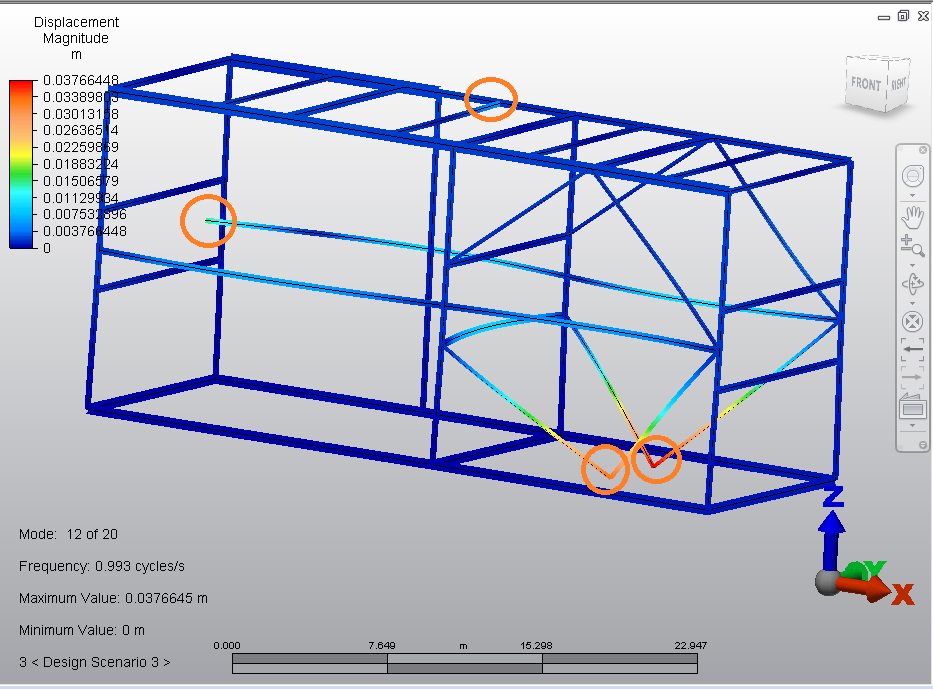
My guess is that 39% for the Z direction in this model is like 70% or 80% or 90% in a different model. Because of the constraints, some of the mass is prevented from moving in the Z direction, so it is not possible to vibrate most or all of the mass in the Z direction. In other words, the total mass participation will never approach 100% in the Z direction. I suspect that 39% for this model is acceptable, but I do not know how to prove that (other than using smaller elements and running more natural frequencies to see if the results change.)
3. The xMin, xMax, yMin, and yMax are only for "zooming in" on the graph. (Change the values, and you will see what I mean.) These values have no effect on the analysis.
For the "Approximation" versus the "Std. Numerical Integration" methods, I suggest you look at the Help to see which one applies to your case. If you do not have any cross-mode effects, then the approximation method is a faster solution.
The Cluster value changes how the results of two frequencies of the "same value" (or "closely-spaced") are treated. If the frequency results are widely separated, then the Cluster value has no effect on the results. If there are closely spaces frequencies, what ever guidelines you are following may provide a value to distinguish "closely spaced" or "well spaced" frequencies. (If my memory is correct, 10% is a typical value (cluster=0.1).)
The damping should be the correct value for your structure. This is usually determined from physical tests on the structure.
John Holtz, P.E. Global Product Support
Autodesk, Inc. If not provided, indicate the version of Inventor Nastran you are using.If the issue is related to a model, attach the model! See What files to provide when the model is needed.