The Stage That Changed My Career
I remember the moment clearly. WorldSkills Special Edition 2022, Bordeaux, France. Representing India in Skill — Digital Construction. Twenty plus countries on the floor. The best young BIM professionals in the world, side by side, working to professional delivery standards under a ticking clock.
Before that day, I had already won the IndiaSkills 2021 National Gold Medal in Digital Construction — the competition that opened the door to the global stage. But nothing fully prepares you for the pressure of a WorldSkills international. Not training. Not mock tasks. Not even the national final.
 WorldSkills 2022, Bordeaux
What WorldSkills gave me in those days of competition - speed without compromise, standards applied instinctively, coordination thinking across disciplines, resilience under an incomplete brief. I have carried into every BIM project, every client delivery, and every mentoring conversation I have had since.
This is not a story about a championship. It is a story about what the best skills competition in the world is doing to build the next generation of BIM professionals — and why, as an industry, we should be paying far closer attention.
What WorldSkills Digital Construction Actually Is
WorldSkills is the global championship for vocational and professional skills. Often called the "Skills Olympics", it brings together over 1,400 competitors from 70 plus countries every two years, competing across 59 technical skill categories. Digital Construction Skill is dedicated entirely to Building Information Modelling.
The competition is not theoretical. Competitors receive a real project brief and must deliver a fully coordinated BIM model — structural, architectural, and MEP coordination — to professional standard, within strict time limits, using the same tools and standards used on live construction projects globally:
-
Autodesk Revit — Parametric modelling, documentation, view creation, annotation
-
Autodesk Navisworks — Model federation, clash detection, coordination review
-
Autodesk Construction Cloud (ACC / Forma) — CDE, cloud collaboration, information management
Competitors are assessed against ISO 19650 information management standards — naming conventions, container structure, metadata, and deliverable quality. Not as an exam. As a graded, industry-equivalent output. The marking criteria mirror what a BIM manager would expect from a professional coordinator on day one of a live project.
This is the BIM Olympics. And Autodesk is one of its most committed global partners.
Autodesk at the Heart of the Competition
Autodesk is an official global sponsor of 13 WorldSkills skill categories, including Skill - Digital Construction. Their involvement goes well beyond providing software licences. Across every country where Digital Construction is competed — from India to Ireland, from the UK to France, from Korea to Brazil — competitors train and compete on Autodesk Revit, Navisworks, and ACC. These are the professional tools they will use for their upcoming careers, and WorldSkills ensures that by the time they enter the industry, they are not learning them on the job.
In the UK, WorldSkills UK Digital Construction competitors receive full access to the Autodesk AEC Collection as part of an 18-month intensive Squad training programme. In Ireland, the WorldSkills Ireland Digital Construction competition is built around Autodesk technology. In India, every IndiaSkills competitor in Digital Construction trains on the same Autodesk stack from their first qualifier.
The results from WorldSkills Lyon 2024 shows the global scale, competitiveness and quality of this pipeline.
Every one of these competitors delivered a coordinated BIM model in Revit, coordinated in Navisworks, managed through ACC — to a standard that the vast majority of early-career professionals in the industry cannot match.
 WorldSkills 2024 Lyon
What the Competition Builds That the Classroom Cannot
As an Autodesk Expert Elite and someone who has been through the WorldSkills journey personally, I am often asked by educators and employers what the competition actually develops. The honest answer is: the things that are hardest to teach.
Speed Under Pressure Without Sacrificing Quality
Competition tasks are designed to be achievable — but only if you are genuinely proficient. There is no time to look up a tutorial. You must know Revit's model structure, view templates, shared parameters, and coordination workflow instinctively. The timed environment compresses years of professional experience into days of competition.
ISO 19650 as a Living Practice, Not a Theory
In a university setting, ISO 19650 is a framework you study. In a WorldSkills competition, it is a marking criterion you are assessed against in real time. Competitors who have been through the process understand information management standards not because they memorised them, but because a judge deducted marks when they did not apply them.
Interpreting an Incomplete Brief
Real projects are never perfectly specified. Competition tasks deliberately include ambiguity — gaps, contradictions, and decisions left to the competitor's professional judgement. This mirrors precisely what a BIM coordinator faces on a live project. It is a skill that cannot be taught in a lecture. It has to be experienced.
Multi-Discipline Coordination Thinking
Digital Construction tasks span architectural, structural, and MEP elements — all within the same competition session. Competitors develop a federated model mindset that most early-career professionals take years to build through live project exposure. They arrive in the industry already thinking across disciplines, not just within one.
Resilience and Professional Self-Management
Four days. A global audience. Unexpected technical challenges. Tight deliverable windows. A competitor who has stood on the WorldSkills floor has already experienced the kind of professional pressure that most people only encounter years into their career. That resilience is visible the moment they step onto a construction project.
The Industry Impact: A Self-Reinforcing Talent Pipeline
The alumni of WorldSkills Digital Construction are already shaping the AEC industry globally. Luke O'Keeffe of Ireland, gold medalist at WSC Bordeaux 2022 is now Head of Digital Project Delivery at one of leading construction firm. Isabelle Barron of the UK, gold medalist at EuroSkills 2023, who now coaches the next Squad UK generation preparing for Shanghai 2026.
Keval Solanki, IndiaSkills 2021 gold medallist in Digital Construction (yes, that is me 😅) now working as a Senior BIM Consultant and Autodesk Expert Elite in Ireland. Outside of live project delivery, I tutor and mentor BIM freshers and Masters students in Construction Management back in India — because the best thing a competition can produce is not just a better professional, but one who pulls the next generation up with them. Competitors from India, France, Germany, Austria, Korea, Chinese Taipei, Brazil and more who are now BIM coordinators, digital construction leads, and Autodesk power users on major projects worldwide.
That is the model. Compete. Excel. Return. Give back. The WorldSkills Digital Construction pipeline does not just produce medal winners, it produces the industry's future trainers, mentors, and thought leaders. And with WorldSkills Shanghai 2026 on the horizon, the next chapter of that story is already being written.
And the competition is not standing still. WorldSkills Shanghai 2026 (September 22–27, 2026) will introduce new task types — including Autodesk Forma site design workflows, a category never seen at WorldSkills before — reflecting exactly where the industry is heading. The competition tracks the profession, not the past. Future cycles are already exploring AI-assisted BIM workflows and cloud-first delivery, which means competitors preparing for WorldSkills Aichi 2028 will be training on the tools that define the AEC industry of 2030.
The Voices From the Floor: What Competitors Actually Say
The most powerful thing about WorldSkills is not the medals. It is what the experience does to the people who go through it. Autodesk in one of its article has documented the journeys of competitors across the globe preparing for the international stage, and the message from every one of them is consistent — this competition changes how you see yourself as a professional.
Isabelle Barron, who won gold at EuroSkills 2023 and went on to compete in Digital Construction at WorldSkills Lyon 2024 representing the UK, captures exactly what Autodesk's partnership means in practice.
"With Autodesk as a WorldSkills sponsor and using Autodesk software throughout is a really great way to get that hands-on experience of what's widely used in industry and being ready for it."
I could have written those words myself. The competition raised the ceiling of what I thought was possible with Revit and a project standards and then it raised it again. And when I returned to the industry after WSC Bordeaux 2022, I did not come back as the same professional who had left. The confidence, the standard, the instinct for precision — all of it came with me.
For me personally, the journey started as a Masters student at CEPT University in India where I first put my hands on Autodesk software and realised what was possible with a BIM model in the right hands. WorldSkills became the bridge between that academic foundation and a professional career. It took me from the classroom in India, to the national competition stage at IndiaSkills, to the global floor at WorldSkills Bordeaux 2022 — and eventually to leading BIM and digital construction career in India & Ireland, working with increasingly complex, multi-stakeholder projects where digital delivery is not a choice but a standard expectation.
Each step of that journey — from student to Indian BIM industry to Irish BIM construction — was powered by the same Autodesk tools I first used competitively. The software gave me a language that the global AEC industry speaks. And the competition gave me the discipline to speak it fluently.
WorldSkills has a tagline that has stayed with me since the day I first encountered it: "Skills Change the World." I am not just living that line. I am contributing to it — through every project delivered, every model coordinated, and every student and competitor I mentor toward the same stage I once stood on.
That is the compounding return of WorldSkills. The medal is one day. The skills are a career.
As an Autodesk Expert Elite, I believe the WorldSkills Digital Construction pipeline deserves far more visibility within our community than it currently gets. Here is what I would ask of three groups:
For Students and Early-Career Professionals — find your national competition pathway. IndiaSkills, WorldSkills Ireland, WorldSkills UK, your national qualifier. Enter it. The worst outcome is you become significantly better at Revit, Navisworks, and ACC under pressure. The best outcome is a journey that changes your career trajectory entirely — as it did mine.
For Educators and Training Providers — integrate WorldSkills task types and marking criteria into your BIM programmes. The competition's technical standards are a ready-made framework for teaching BIM to professional delivery level, not just academic standard. If your students are graduating without having worked under ISO 19650 deliverable conditions, they are being underprepared.
For Industry Professionals and Employers — can seek WorldSkills Digital Construction alumni in your hiring pipeline. A candidate who has competed nationally or internationally arrives with a level of Autodesk proficiency, standards awareness, and professional resilience that is genuinely rare in early-career talent. They do not need to be onboarded to Revit, Forma, Navisworks or BIM workflow & standards. They arrive ready to contribute.
WorldSkills Shanghai 2026 is three months away. Somewhere right now, a young BIM professional in India, Ireland, the UK, France, or Germany has Revit open, a competition task on screen, and a clock running. They are building the skills that will define the AEC industry of the next decade.
That is not just a competition. That is the future of our profession — training itself.
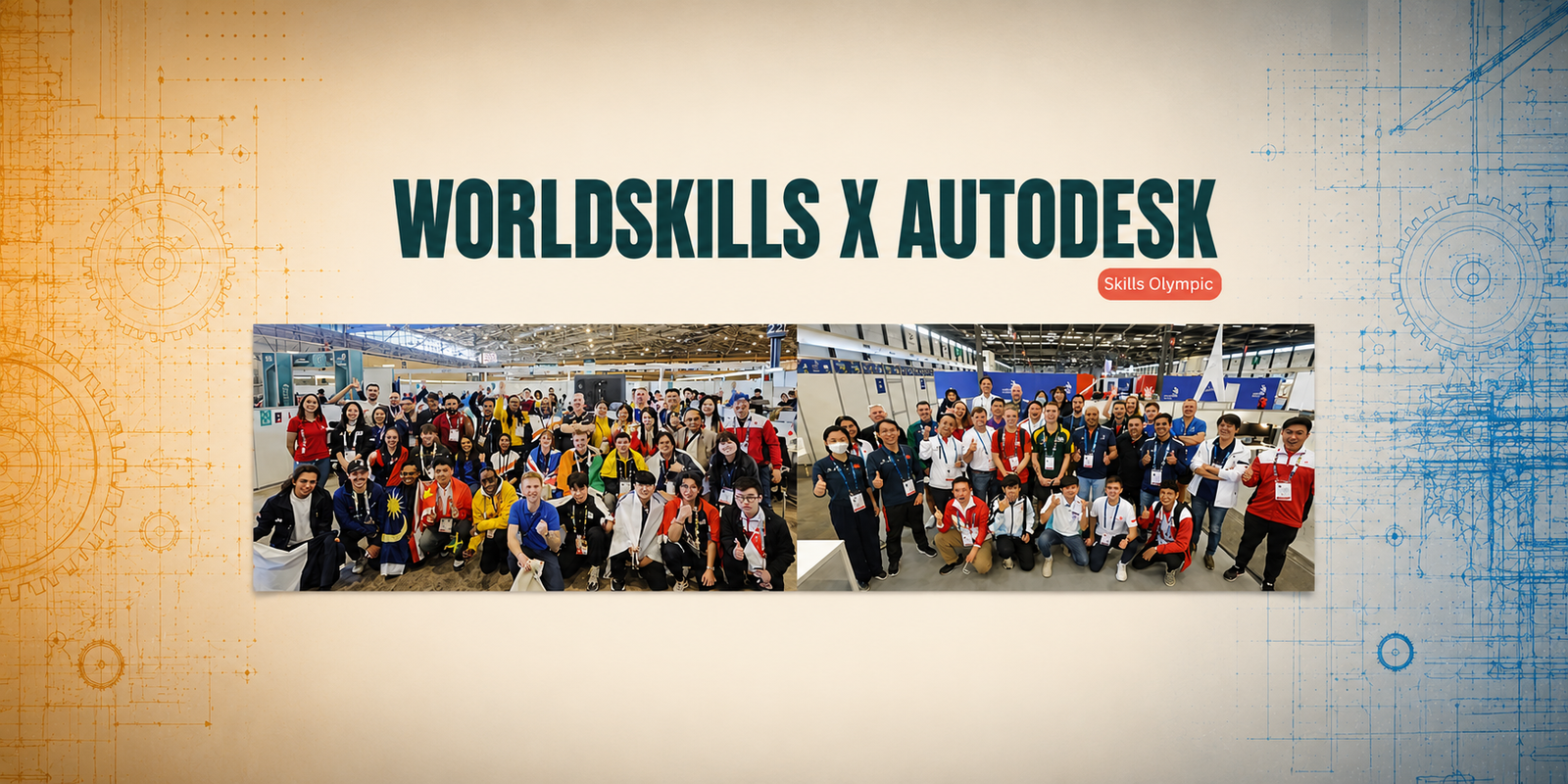
Cover image has been modified for fit using AI.



You must be a registered user to add a comment. If you've already registered, sign in. Otherwise, register and sign in.