- Mark as New
- Bookmark
- Subscribe
- Mute
- Subscribe to RSS Feed
- Permalink
- Report
Hello,
Here is the description of film coefficient in the Autodesk CFD 2017 user guide:
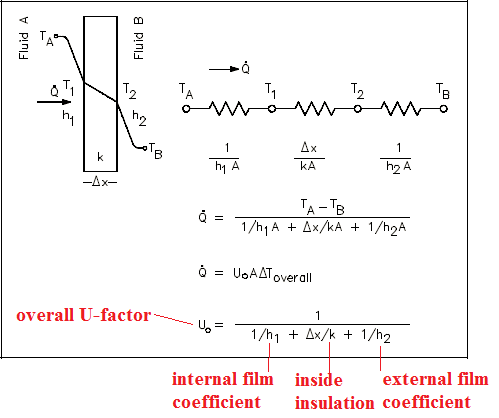
To account for both conduction through the volume as well as convection off the surface, assign a film coefficient boundary condition to the inside surfaces of suppressed walls, windows, or roofs. Assign a value that is the inverse of the R-value for walls or the U factor for windows:
- To simulate a wall with a total effective R value of R19, apply a film coefficient of 0.05 BTU/ft⊃2;/h/R.
- To simulate a window with a U factor of 0.30, apply a film coefficient of 0.30 BTU/ft⊃2;/h/R.
My question is:
The value of thermal conductivity (K) will be defined when we assign a specific material type to a geometric volume. Since we have the geometric model, we know the thickness of the material, thus the model already has the R-value(or U-value) information.So in my understanding that we do not need to assign the film coefficient to account for the conduction through the volume.
But why the user guide says that assign a film coefficient boundary condition to the inside surfaces of suppressed walls, windows, or roofs? By the way, I thought we could only assign the boundary conditions on the outer surfaces of a volume, am I wrong?
Solved! Go to Solution.