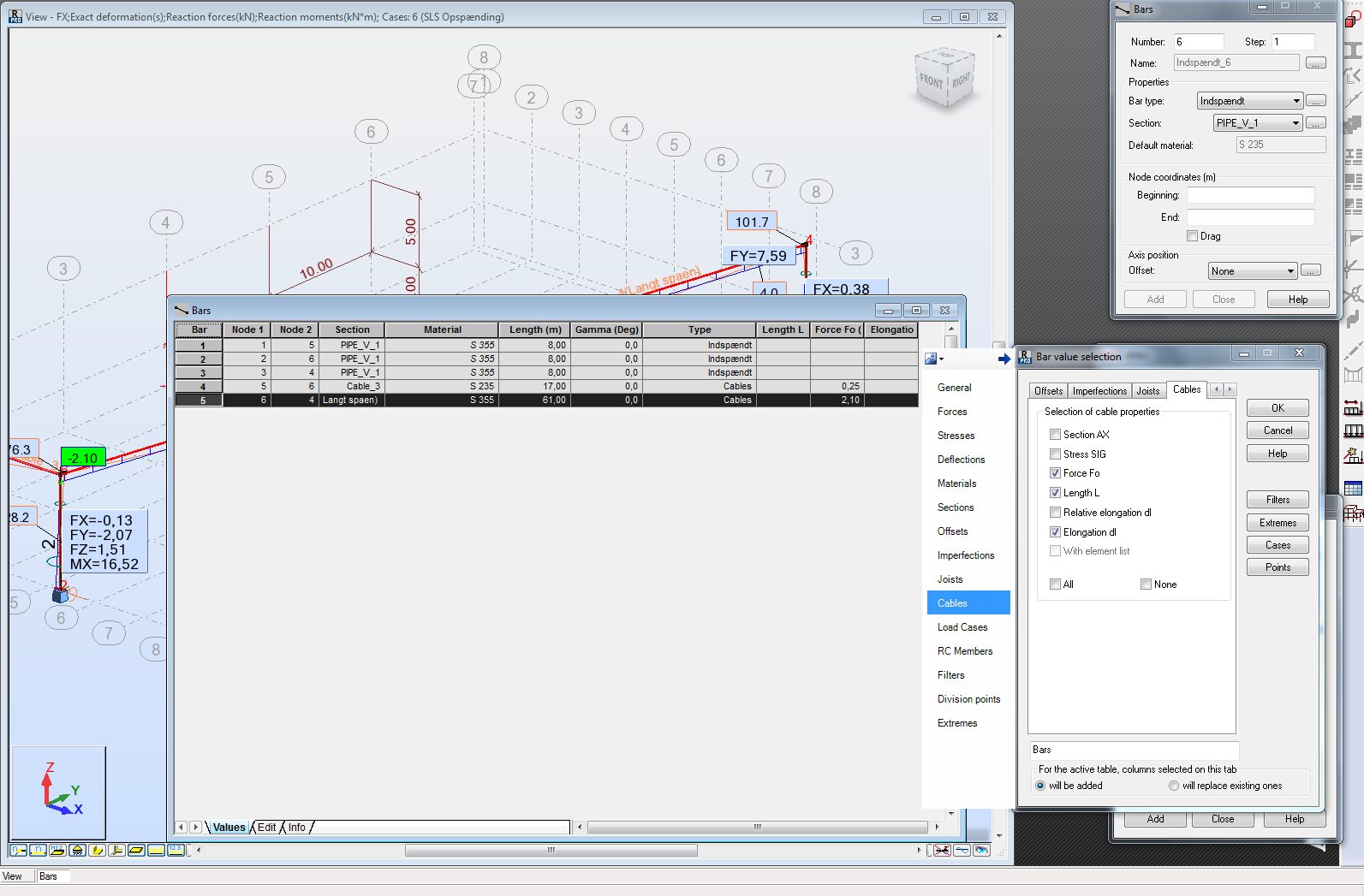
Remarks related to your model:
1/ in structures containing cables the first load case is treated in Robot as assembling load case and it is automatically added to other load cases. That is why it is strongly recommended to apply selfweight and other dead loads in this load case for cable structures. In your model your have applied temperature load in load case 1 and dead loads in load case 2. I have inversed it in my modification of your model
2/ When I checked properties of the cable defined by you I have noticed that you have defined "Cable_2" with elongation of 2 meters. The distance of end nodes of this cable is 16 meters so cable elongation of 2 meters corresponds to unloaded length of the cable equal 16+2=18 meters. This cable length corresponds to the sag of this cable under dead loads exceeding 3 meters. I have modified it replacing it by relative elongation and finding (iteratively) such value of it that the cable sag for load case 1 is close to 2000mm. In such case after applying temperature load of -40 deg the sag is reduced only very slightly to 1989mm and the horizontal reaction is also changing very slightly - from 0.4891 kN to 0.4921 kN (see the screen capture below). It is so because the starting sag of the cable is significant, tension force in the cable is low and shortening of the cable caused by negative temperature is relatively small.Attached the model modified this way
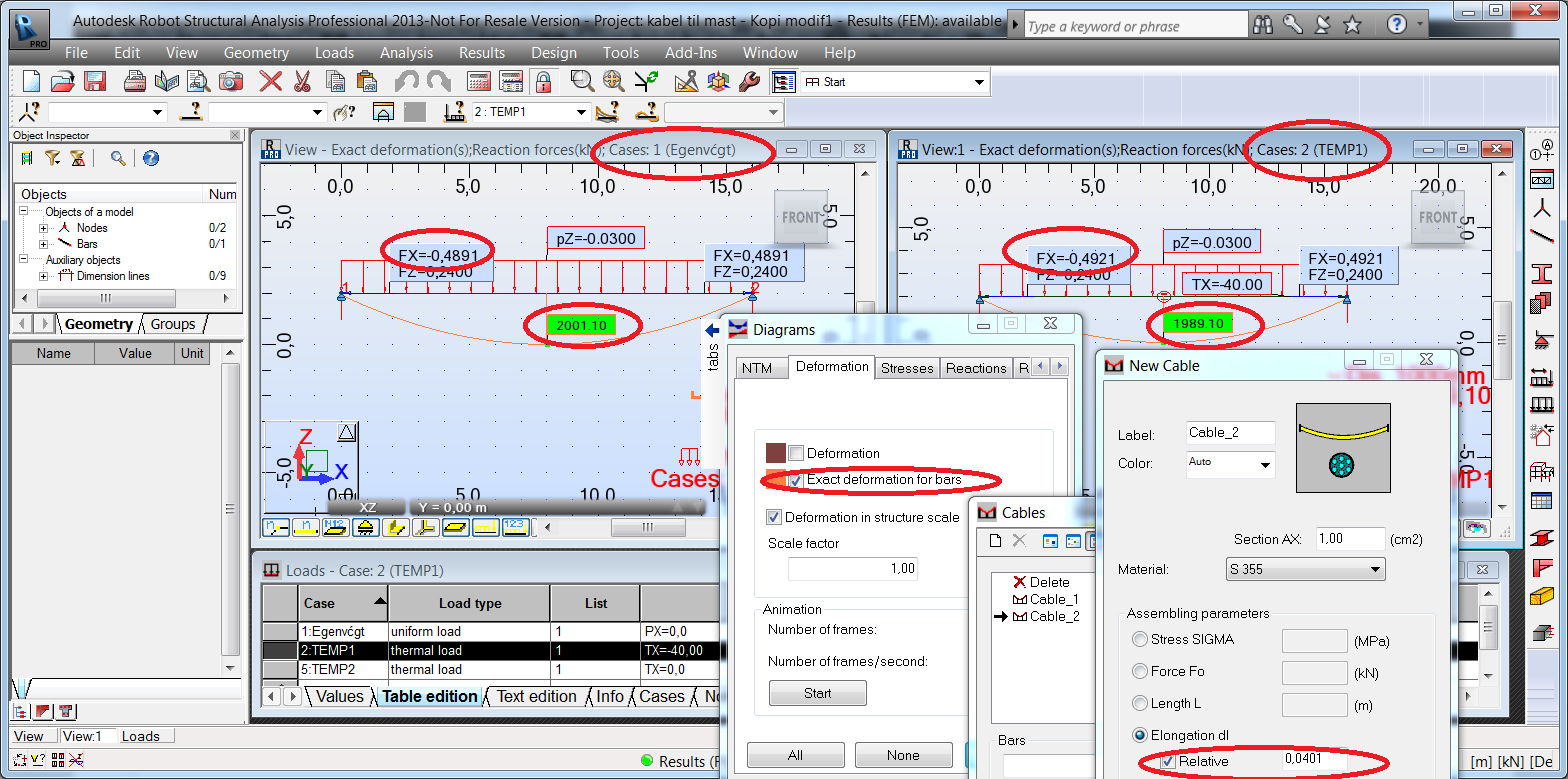
The influence of temperature load would be more visible for the cable with smaller elongation and sag
3/ Other remarks related to the model
- I have not touched other properties of the cable - section of 1cm2=100mm2, material S 355. Probably it will be necessary to define something closer to reality:)
- there is no self-weight defined in load case 1 - I assume that UDL of -0.03 kN/m takes into account the self-weight of the cable
- there is no problem to consider in one model also the columns shown in the drawing from the 1st post
Regards,
 Pawel Pulak
Technical Account Specialist