Community
PowerMill Forum
Welcome to Autodesk’s PowerMill Forums. Share your knowledge, ask questions, and explore popular PowerMill topics.
Turn on suggestions
Auto-suggest helps you quickly narrow down your search results by suggesting possible matches as you type.
 This page has been translated for your convenience with an automatic translation service. This is not an official translation and may contain errors and inaccurate translations. Autodesk does not warrant, either expressly or implied, the accuracy, reliability or completeness of the information translated by the machine translation service and will not be liable for damages or losses caused by the trust placed in the translation service.
Translate
This page has been translated for your convenience with an automatic translation service. This is not an official translation and may contain errors and inaccurate translations. Autodesk does not warrant, either expressly or implied, the accuracy, reliability or completeness of the information translated by the machine translation service and will not be liable for damages or losses caused by the trust placed in the translation service.
Translate
Reply
Topic Options
- Subscribe to RSS Feed
- Mark Topic as New
- Mark Topic as Read
- Float this Topic for Current User
- Bookmark
- Subscribe
- Printer Friendly Page
Message 1 of 21


06-27-2018
02:07 AM
- Mark as New
- Bookmark
- Subscribe
- Mute
- Subscribe to RSS Feed
- Permalink
- Report
06-27-2018
02:07 AM
thickness set for fixtures
Hi After importing an electrode model into Pm2016, I separate the model to two layers, one for the electrode holder, and one for the electrode. In the default thickness set, I add the surfaces of the holder to a set, with "Collision" setting, with 0.1mm thickness. There would be no problem, if I do not use negative thickness values in the toolpaths.. But when I define -0.3 mm thickness, the result of the thicknesses will be 0.1-0.3 = -0.2! How should I define the 0.1mm absolute clearance for the holder?
Thanks in advance
20 REPLIES 20
Message 2 of 21

06-27-2018
04:00 AM
- Mark as New
- Bookmark
- Subscribe
- Mute
- Subscribe to RSS Feed
- Permalink
- Report
06-27-2018
04:00 AM
Hi.kukelyk
Did you make the PMill project using a template object?
"If you create a template object with the default thickness set value other than 0,
It does not work properly "
I have been told by the Japanese support center.
(Although it was not a problem in 2013, it was said that it will be a problem in 2017)

Message 3 of 21
06-27-2018
04:23 AM
- Mark as New
- Bookmark
- Subscribe
- Mute
- Subscribe to RSS Feed
- Permalink
- Report
06-27-2018
04:23 AM
nope, it is a standard way (stored in a macro):
-import parasolid model
-separate them
-add holder surfaces to thickness set.
Message 4 of 21

06-27-2018
04:35 AM
- Mark as New
- Bookmark
- Subscribe
- Mute
- Subscribe to RSS Feed
- Permalink
- Report
06-27-2018
04:35 AM
Hey @kukelyk
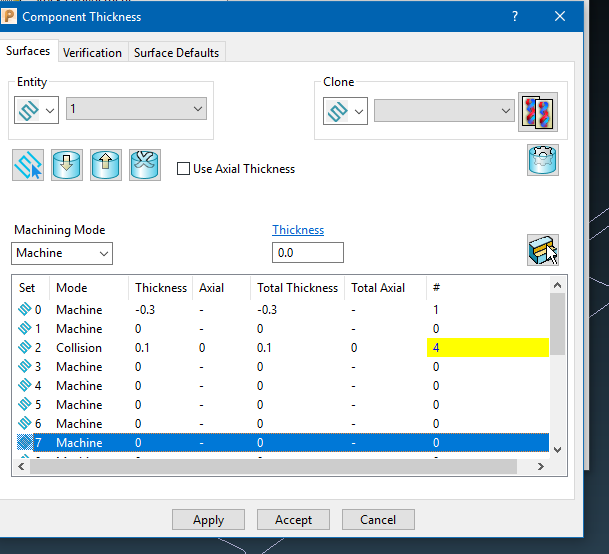
I don't have 2016 installed anymore but I tried doing this in 2019 and it seems to keep the collision set at .1, try it in 2019 or am I doing something different from what you are?
Intel Core i9 13900KF CPU
128 GB Kingston Beast DDR4 SDRAM
PNY RTX A2000 6GB Video Card
WD 1 TB SSD Hard Drive
Windows 11 Pro
Message 5 of 21
06-27-2018
04:42 AM
- Mark as New
- Bookmark
- Subscribe
- Mute
- Subscribe to RSS Feed
- Permalink
- Report
06-27-2018
04:42 AM
Sorry @kukelyk I didn't have the negative thickness set in my toolpath in the previous post. When I did it was the same result as yours, so what my workaround was to add .4 mm of thickness to the collisions set to give me the .1 clearance.

Intel Core i9 13900KF CPU
128 GB Kingston Beast DDR4 SDRAM
PNY RTX A2000 6GB Video Card
WD 1 TB SSD Hard Drive
Windows 11 Pro
Message 6 of 21


06-27-2018
09:52 AM
- Mark as New
- Bookmark
- Subscribe
- Mute
- Subscribe to RSS Feed
- Permalink
- Report
06-27-2018
09:52 AM
@kukelyk wrote:Hi After importing an electrode model into Pm2016, I separate the model to two layers, one for the electrode holder, and one for the electrode. In the default thickness set, I add the surfaces of the holder to a set, with "Collision" setting, with 0.1mm thickness. There would be no problem, if I do not use negative thickness values in the toolpaths.. But when I define -0.3 mm thickness, the result of the thicknesses will be 0.1-0.3 = -0.2! How should I define the 0.1mm absolute clearance for the holder?
Thanks in advance
Hi Kukelyk,
Thanks for posting in Autodesk Community!!!
With regards to you recent query of collision in component thickness, i share my point of view to resolve. The collision option help you to select to add component thickness to a component which will not be machined but must be avoided (such as a clamp). I prepared a short video which will clear you query very closely. If my post answers your query, please click on 'Accept as Solution' button.

Thanks,
Sudhira Dora
Message 7 of 21

06-27-2018
05:35 PM
- Mark as New
- Bookmark
- Subscribe
- Mute
- Subscribe to RSS Feed
- Permalink
- Report
06-27-2018
05:35 PM
I do not think there's any way to do that.
You could enter a question in your macro and enter the smallest value.
The macro does the account and already inserts a safe value.
Not ideal. But I see no other way to do that.
Rafael Sansão
Message 8 of 21
06-27-2018
11:31 PM
- Mark as New
- Bookmark
- Subscribe
- Mute
- Subscribe to RSS Feed
- Permalink
- Report
Message 10 of 21
06-27-2018
11:40 PM
- Mark as New
- Bookmark
- Subscribe
- Mute
- Subscribe to RSS Feed
- Permalink
- Report
06-27-2018
11:40 PM
Yes @rafael.sansao, I think so too, but a CAM system (with the cost of PMill..) should treat fixtures and clamps...
The toolpath thickness and the fixture clearance are independent parameters of each other (in Siemens NX for example)
Message 11 of 21
06-28-2018
04:14 AM
- Mark as New
- Bookmark
- Subscribe
- Mute
- Subscribe to RSS Feed
- Permalink
- Report
06-28-2018
04:14 AM
@kukelyk It worked on mine end, are we doing something different than you?
See attached video here and project. Project was done in 2019
Intel Core i9 13900KF CPU
128 GB Kingston Beast DDR4 SDRAM
PNY RTX A2000 6GB Video Card
WD 1 TB SSD Hard Drive
Windows 11 Pro
Message 14 of 21
06-28-2018
04:45 AM
- Mark as New
- Bookmark
- Subscribe
- Mute
- Subscribe to RSS Feed
- Permalink
- Report
06-28-2018
04:45 AM
Here is the 2018 version
Intel Core i9 13900KF CPU
128 GB Kingston Beast DDR4 SDRAM
PNY RTX A2000 6GB Video Card
WD 1 TB SSD Hard Drive
Windows 11 Pro
Message 15 of 21
06-28-2018
05:15 AM
- Mark as New
- Bookmark
- Subscribe
- Mute
- Subscribe to RSS Feed
- Permalink
- Report
06-28-2018
05:15 AM
Ok, if You increase the thickness set's thickness value greater then the undercut, then everything is ok, but I rather not change this value...
I cannot believe that there is no direct way for this...
Message 16 of 21
06-28-2018
05:27 AM
- Mark as New
- Bookmark
- Subscribe
- Mute
- Subscribe to RSS Feed
- Permalink
- Report
06-28-2018
05:27 AM
I agree, the only other thing I can think of is to scale your clamps bigger by your negative thickness value which you can than add .1 thickness but that is kinda the same thing as my original idea
Intel Core i9 13900KF CPU
128 GB Kingston Beast DDR4 SDRAM
PNY RTX A2000 6GB Video Card
WD 1 TB SSD Hard Drive
Windows 11 Pro
Message 17 of 21
06-29-2018
05:45 AM
- Mark as New
- Bookmark
- Subscribe
- Mute
- Subscribe to RSS Feed
- Permalink
- Report
06-29-2018
05:45 AM
according to @craig.chester : https://forums.autodesk.com/t5/powermill-forum/powermill-2019/m-p/7927529#M9741
They are working on . Will be a nice improvement.
Message 18 of 21
06-29-2018
07:14 AM
- Mark as New
- Bookmark
- Subscribe
- Mute
- Subscribe to RSS Feed
- Permalink
- Report
06-29-2018
07:14 AM
Use a macro to check the right settings ?
function main() {

REAL MinimalSecurityThickness=0.1

GRAPHICS LOCK
// Ensure ECHO COMMANDS is OFF
DIALOGS MESSAGE OFF
ECHO OFF DCPDEBUG UNTRACE COMMAND ACCEPT
INT ThicknessSetNr=0
  STRING $TpName = ''
  FOREACH ent IN REVERSE(FOLDER('Toolpath')) {
		$TpName = ent.Name
		ENTITY $Tp = ENTITY('toolpath', $TpName)
		$ThicknessSetNr=0
		REAL Tp_Thickness = ent.Thickness
		REAL CorrectValue= $MinimalSecurityThickness-$Tp_Thickness

		IF $Tp_Thickness <0 {
				DO {
					STRING ThickMode=$ent.ThicknessSetValues[$ThicknessSetNr].Mode
					REAL ActThickness=$ent.ThicknessSetValues[$ThicknessSetNr].Thickness
					IF $ThickMode=="collision_check" {
					IF ($ActThickness+$Tp_Thickness)!= $MinimalSecurityThickness {
						MESSAGE ERROR "Wrong Thickness on collision_check for $TpName"
						UNLOCK TOOLPATH $TpName
						INVALIDATE TOOLPATH $TpName
						ACTIVATE TOOLPATH $TpName
						// $Tp.ThicknessSetValues[$ThicknessSetNr].Thickness=$CorrectValue
						EDIT TOOLPATH THICKNESS LIST UPDATE\r $ThicknessSetNr NEW
						EDIT TOOLPATH ; THICKNESS RADIAL_OFFSET $CorrectValue
						THICKNESS APPLY
						YES
						THICKNESS ACCEPT
					}
					}
					$ThicknessSetNr=$ThicknessSetNr+1
				} WHILE $ThicknessSetNr < 15
		}
	}

GRAPHICS UNLOCK
}
Message 19 of 21
07-02-2018
02:56 AM
- Mark as New
- Bookmark
- Subscribe
- Mute
- Subscribe to RSS Feed
- Permalink
- Report
07-02-2018
02:56 AM
It seems that I have to modify my macros to increase the thickness set's thickness value( with the spark gap) to get safe toolpaths. It is the cleanest solution, I think.
Message 20 of 21
07-03-2018
03:09 AM
- Mark as New
- Bookmark
- Subscribe
- Mute
- Subscribe to RSS Feed
- Permalink
- Report
07-03-2018
03:09 AM
Hi kukelyk.
In order to avoid this problem I used a spark gap
It is not the thickness of the toolpath, it is set on the 'Component Thickness' side.

First, set the thickness including the 'Surface Defaults'.
Before batch processing, settings are copied to all the toolpaths with macro.
I do not know how to set the spark gap with 'Component Thickness' but it works.
Because it takes a lot of time to check 'Component Thickness',
I made a macro and attached it to 'MESSAGE 67' yesterday.
I do not understand English, so there is a possibility that the words are wrong. We apologize in advance.

Reply
Topic Options
- Subscribe to RSS Feed
- Mark Topic as New
- Mark Topic as Read
- Float this Topic for Current User
- Bookmark
- Subscribe
- Printer Friendly Page