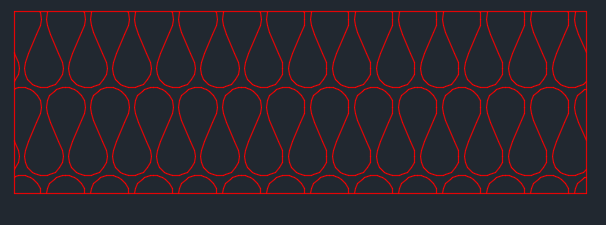
One Line Insulation Hatch

One Line Insulation Hatch

Anonymous
Not applicable
115,414 Views
13 Replies
Message 1 of 14

One Line Insulation Hatch

Anonymous
Not applicable

Hello,


I already have this insulation hatch .pat bellow:

hatch insulation.PNG


But i need that hatch with 1 line, like that:

pline insulation.PNG

(this is a pline, not a hatch.)


The .pat archive is attached.


Someone can help me?


Thank you.


0 Likes
Accepted solutions (2)
115,415 Views
13 Replies
Replies (13)
Message 2 of 14

pendean
Community Legend
Community Legend
hatches don't really work like that: use the linetype like in your second screenshot instead.
Message 3 of 14

Kent1Cooper
Consultant
Consultant
Accepted solution

Yes, you can do that with the Hatch pattern.  If you mean you want a single row of that pattern, such as to show insulation in a wall, you can do it with some care about the boundary, scale and origin, and of course the rotation angle when the wall direction isn't horizontal.


InsulHatch.PNG


That pattern is defined at 100 drawing units "high" per row of squiggles, so use a scale of the thickness divided by 100.


If, on the other hand, you actually want a squiggly Polyline end result, rather than a Hatch pattern or via AutoCAD's Batting linetype, there are a variety of routines that will do that.  My favorite is my own InsulBattPoly.lsp, available here.  Be sure to look at the image in my first comment there -- it's pretty juicy, and even works along curved paths.  If you Search further for "insulation" just on that Cadalyst CAD Tips website, there are several other routines for Polyline results [as well as for other Hatch patterns].  I went through checking them out a while back, and added comments at their individual pages about things like whether the loops touch [as in my routine and the Batting linetype] or not [as in the above Hatch pattern], what kind of input you have to give it, some drawbacks to a few of them, etc., etc.

Kent Cooper, AIA
Message 4 of 14

Anonymous
Not applicable

Ok then.


Thank You.

0 Likes
Message 5 of 14

elshawadfy
Collaborator
Collaborator
Accepted solution

Hi @Anonymous,

 Another solution (Borrowed from a previous suggestion of @Alfred.NESWADBA I believe in a similar situation- Sorry I don't recall the topic)


You can create a"MLSTYLE" (MultiLine Style) with the middle line type set to "Batting"..


The beauty of the solution is that it well align it self with sloped and perpendicular lines..


You can Adjust the thickness by adjusting the Scale of the "MLine"


Batting.jpg


DWG attached..


Regards 🙂


Message 6 of 14

pendean
Community Legend
Community Legend
"Wall" hatches are rarely done in single lines: while a nice workaround for occasional use it's not a viable production-mode solution. @elshawadfy is a viable alternative if the OP already uses MLINEs for their "walls".
Message 7 of 14

Kent1Cooper
Consultant
Consultant

@pendean wrote:
"Wall" hatches are rarely done in single lines: ....

Maybe so, and I never do it that way myself, but it's exactly what the OP asked how to do, so....

Kent Cooper, AIA
0 Likes
Message 8 of 14

Tommy2shoes
Participant
Participant

Another nice thing about the multiline method is that you can use it for the boundary of an associative hatch. Though it will not rotate at the vertexes.

0 Likes
Message 9 of 14

Anonymous
Not applicable

I want insulation hatcg

0 Likes
Message 10 of 14

Kent1Cooper
Consultant
Consultant

@Anonymous wrote:

I want insulation hatcg


So have you tried the pattern attached to Message 1?  Or looked at the Cadalyst CAD Tips site linked in Message 3?  Or Searched the web [there are very many  websites with free hatch patterns]?  If nothing from those sources works for you, what do you want to be different?

Kent Cooper, AIA
0 Likes
Message 11 of 14

Tommy2shoes
Participant
Participant

Since no one knows what you want it for there could be several ways to solve the problem. Hatch patterns with anything round (except for super hatches) is very difficult to make & will not follow a path. Maybe you can try to measure a path with a simple S block. The path would be a temporary construction line. Why you can't settle for the batting line style though remains a mystery.Measure command battingMeasure command batting

0 Likes
Message 12 of 14

Tommy2shoes
Participant
Participant

If you use the array command you can keep the association with the construction line

0 Likes
Message 13 of 14

charleneHXVGM
Observer
Observer

Hello, how do you rotate the hatch? I was able to load it on my Revit as a pattern but there's no option to rotate it vertically. Thank you in advance.

0 Likes
Message 14 of 14

pendean
Community Legend
Community Legend
@charleneHXVGM This is not the REVIT support forum: that is over here https://forums.autodesk.com/t5/revit-products/ct-p/2003

HTH
0 Likes