Inviscid Analysis

Inviscid Analysis

Anonymous
Not applicable
6,279 Views
25 Replies
Message 1 of 26

Inviscid Analysis

Anonymous
Not applicable

Does anybody have an idea of how one might approach an inviscid (essentially potential flow) analysis using CFDesign/Simulation CFD?  Is this even possible?  Any advice would be appreciated.  Thanks.

Accepted solutions (2)
6,280 Views
25 Replies
Replies (25)
Message 21 of 26

Anonymous
Not applicable

Not perfect, but close!

0 Likes
Message 22 of 26

Anonymous
Not applicable

Royce,

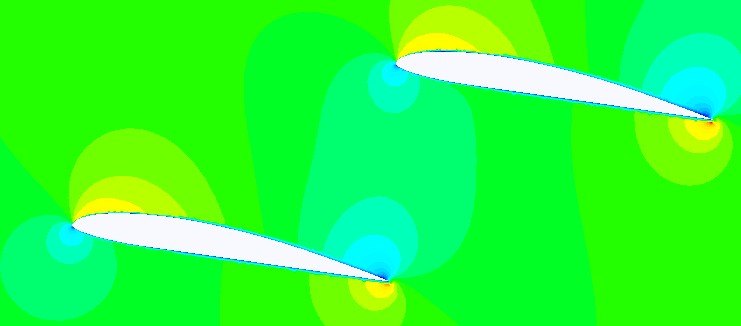
Another issue.  I tried to do this with some different geometry.  I used the same settings, except the analysis is no longer axisymmetric but rather 2D cartesian with multiple bodies.  Instead of the high velocity flow at the wall I am now seeing very low velocity flow at the wall, almost as if there were a boundary forming.   I have attached my share file, if you have a second to look it over I would appreciate it.Screenshot.jpg

0 Likes
Message 23 of 26

Anonymous
Not applicable

Here are the XY coordinates for data extraction.  FYI:  the cp's I gave in the spreadsheet were calculated from the velocity magnitude (rather than the calculated cp).    cp= 1- (v/V)^2  and V=1 m/s so cp = 1 -Vmag^2.

0 Likes
Message 24 of 26

Royce_adsk
Community Manager
Community Manager

Matt,


Turn off the slip boundary conditions for the potential flow simulation.  That is degrading the results.  Go back and try your other problem again after removing the slip boundary conditions and see if that helps with the comarison to your benchmark.


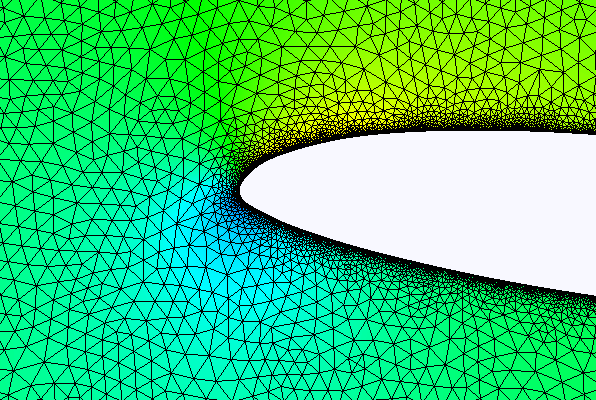
I would also consider changing the edge mesh around the profiles to 3600 elements with no biasing.  Since we have a 2D model that solves in 1 iteration, we might as well increase the mesh around the profiles.


no Slip.png


mesh.png


-Royce


Royce.Abel
Technical Support Manager

Message 25 of 26

Anonymous
Not applicable

Beautiful!  Thanks again.

0 Likes
Message 26 of 26

Anonymous
Not applicable

Hello, 

I am trying to use Simulation CFD 2015 to conduct Laplacian simulations over complex geometries. In Simulation CFD 2015, I do not see a Quick Forced Convection option in the Solve-Physics dialogue. Is the Quick Forced Convection still a setting or has this been phased out?

0 Likes