1) So, the force calculated by me 894,3 kN is too small, because it calculated for impact lasting t=0.168 sec ? Why did you take for the Time History analysis two lengths of impact t1=0.02 sec and t2=0,01 sec, does it comes from some Norms ?
----------------------------
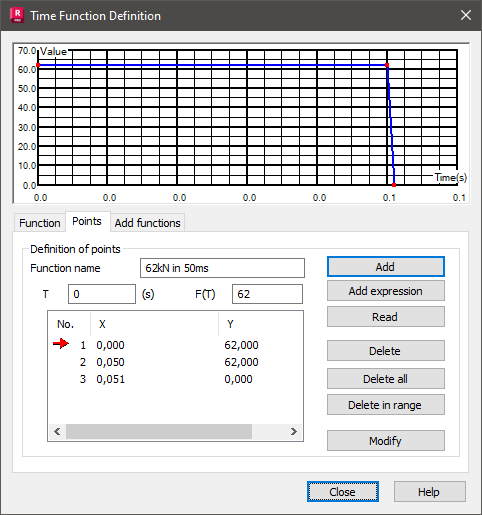
In your original model you have defined the impact of 894.8*63=56340.9kN lasting 0.05 sec and then linearly decreasing to zero during next 0.05 sec.
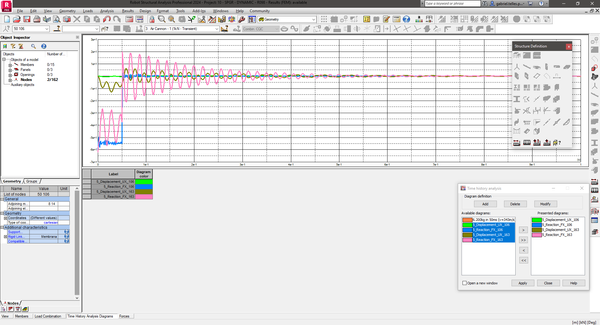
When I have defined (attached model - see load case 15) the impact 894,3 kN lasting t=0.168 sec (forcing function constant during 0.168 sec) the results comparable with shorter impacts but with bigger force (but the same F*t product) were received - see the screen capture below. In load case 15 smaller and delayed response can be observed because the impact time is already comparable with 1/4 of the periods of basic vibration modes of the frame.
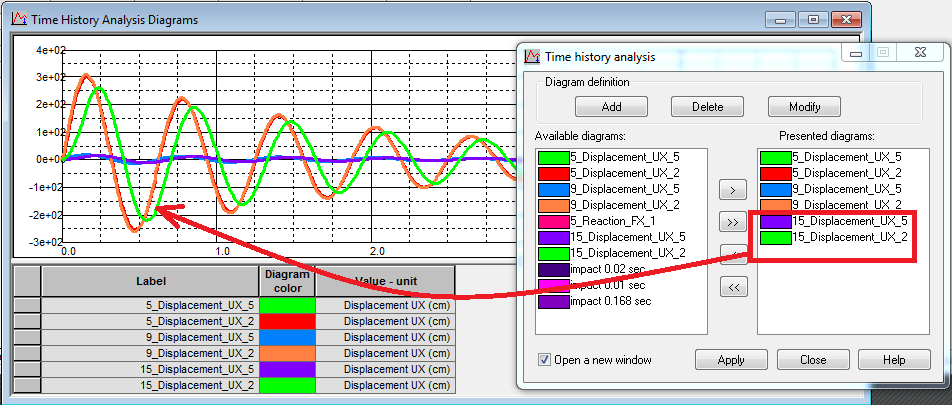
I have taken for the Time History analysis two lengths of impact to illustrate the effect that for short lengths of impact (short in relation to the periods of basic vibration modes of the structure) the response depends on the product F*t and not only the force F. I have not taken it from any norms - pure machanics.
-----------------------------
2) My perpose in Blast analysis to discover the response of structure from impact of truck. I need to ensure that if even one column isn’t resist the impact of truck, the structure itself will be strong enough and not collapse. What is the practical usage of Time History analysis ? How I can get forces from it in proper form(table form or on the screen) for static analysis of the collided column ? If I know force F in advance, for instance, for t=0,01 sec it is F=15000Kn, why I can’t put it STREIGHT in Static analysis and calculate the capacity of the column and general deformation of structure , that benefit I can get from Time History analysis ?
3) Now I found only how to get the forces in graphic view. Please, give me clear explanation how to use the results from Time History analysis ?
-----------------------------
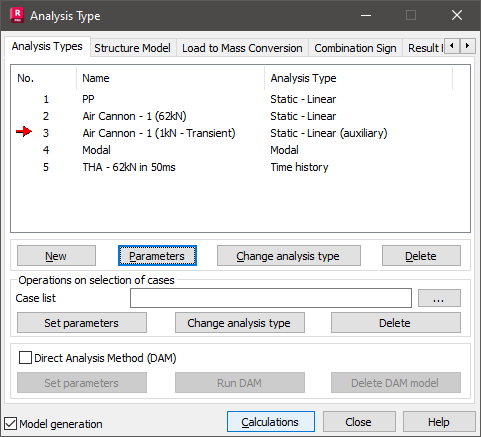
Time history analysis (THA) give results (forces, displacements, moments,etc) in series of time steps.
For instance in my examples it was defined with such paramaters that the results were output in 501 steps from t=0 sec to t=5 sec.
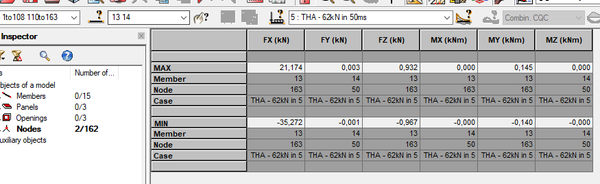
The results of all these steps can be seen in the tables when tables are filtered only to THA case - see below:

In the graphical window the results (deformed shapes, diagrammes of moments,...) can be also displayed for selected time (as if a single picture from the video) selecting THA load case and appropriate component of it:

Direct application of the force of 15000kN as static load case would give completely different (bigger) results than THA because it would correspond to static application of this load without vibrations (constant displacements, forces, moments etc). In case of THA the load is acting very short (0.01 sec in my example) and is resulting in variable in time displacements, forces, moments etc.
When using THA results in design it is the best to find time steps with the extreme forces or moments and to convert them to simple cases - see the green rectangle in the screen capture above. Such cases can be easily combined with other load cases and used in design.
---------------------------------------------
If this post answers your question please click "Accept as Solution". It will help everyone to find answer more quickly!
Regards,
 Pawel Pulak
Technical Account Specialist